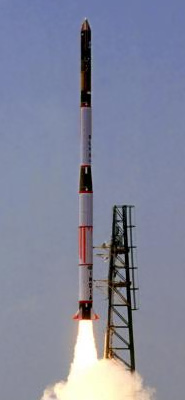
The Satellite Launch Vehicle or SLV is a Small-lift launch vehicle, was a project started in the early 1970s by the Indian Space Research Organisation to develop the technology needed to launch satellites. SLV was intended to reach a height of 400 kilometres (250 mi) and carry a payload of 40 kg (88 lb). The first experimental flight of SLV-3, in August 1979, was a failure. The first successful launch took place on 18 July, 1980.
It was a four-stage rocket with all solid-propellant motors.
The first launch of the SLV took place in Sriharikota on 10 August 1979. The fourth and final launch of the SLV took place on 17 April 1983.
It has taken approximately seven years to realise the vehicle from start. The solid motor case for first and second stage are fabricated from 15 CDV6 steel sheets and third and fourth stages from fibre reinforced plastic.
Launch Stats :

Launch History :
All four SLV launches occurred from the SLV Launch Pad at the Sriharikota High Altitude Range. The first two launches were experimental (E) and the next 2 were designated as developmental (D) as this was the first launch vehicle being developed by India not intended for a long service life.[4]
| Flight No. | Date / time (UTC) | Rocket, Configuration | Launch site | Payload | Payload mass | Orbit | User | Launch outcome |
|---|---|---|---|---|---|---|---|---|
| E1 | 10 August 1979 | Satellite Launch Vehicle | SLV Launch Pad | Rohini Technology Payload | 35 kg | Low Earth | ISRO | Failure |
| Faulty valve caused vehicle to crash into the Bay of Bengal 317 seconds after launch. | ||||||||
| E2 | 18 July 1980 | Satellite Launch Vehicle | SLV Launch Pad | Rohini RS-1 | 35 kg | Low Earth | ISRO | Success |
| It was the first satellite successfully launched by the indigenous launch vehicle SLV. It provided data on the fourth stage of SLV. | ||||||||
| D1 | 31 May 1981 | Satellite Launch Vehicle | SLV Launch Pad | Rohini RS-D1 | 38 kg | Low Earth | ISRO | Partial failure |
| Orbit too low. Decayed after 9 days | ||||||||
| D2 | 17 April 1983 | Satellite Launch Vehicle | SLV Launch Pad | Rohini RS-D2 | 41.5 kg | Low Earth | ISRO | Success |
| Earth Observation satellite |
On May 23, 2016, A modified version of the launcher consisting only the first stage lofted the HEX-1 Reusable Launch Vehicle Technology Demonstrator on a 10-minute mission to 70 kilometers in altitude.
Augmented Satellite Launch Vehicle :
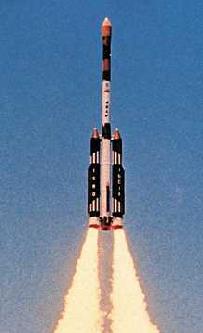
The Augmented Satellite Launch Vehicle or Advanced Satellite Launch Vehicle, also known as ASLV, was a Small-lift launch vehicle five-stage solid-fuel rocket developed by the Indian Space Research Organisation (ISRO) to place 150 kg satellites into LEO.This project was started by India during the early 1980s to develop technologies needed for a payload to be placed into a geostationary orbit. Its design was based on Satellite Launch Vehicle. ISRO did not have sufficient funds for both the Polar Satellite Launch Vehicle programme and the ASLV programme at the same time and the ASLV programme was terminated after the initial developmental flights. The payloads of ASLV were Stretched Rohini Satellites.
Vehicle :
The ASLV was a five-stage vehicle. Two strap-on boosters acted as a first stage, with the core stage igniting after booster burn out. The payload capacity of the ASLV was approximately 150 kg (330 lb) to an orbit of 400 km (250 mi) with a 47-degree inclination.
At liftoff, the ASLV generated 909.9 kN (204,500 lbf) of thrust. It was a 41,000-kilogram (90,000 lb) rocket, measuring 23.5 metres (77 ft) in length with a core diameter of one metre (3 ft 3 in).[4] The height to diameter ratio of ASLV was very large which resulted in the vehicle being unstable in flight. This was compounded by the fact that many of the critical events during a launch like the core ignition and the booster separation happened at the Tropopause where the dynamic loads on the launcher was at the maximum.
History :
The ASLV made four launches, of which one was successful, two failed to achieve orbit, and a third achieved a lower than planned orbit which decayed quickly. The type made its maiden flight on 24 March 1987, and its final flight on 4 May 1994.
Launch Stats :

Launch History :
All four ASLV launches occurred from the ASLV Launch Pad at the Sriharikota Range. For vertically integrated ASLV, many SLV-3 ground facilities were reused but a new launch pad with retractable Mobile Service Structure was constructed within the same launch complex.[6]
| Flight No | Date / time (UTC) | Rocket, Configuration | Launch site | Payload | Payload mass | Orbit | User | Launch outcome |
|---|---|---|---|---|---|---|---|---|
| D1 | 24 March 1987[7] | Satish Dhawan Space Centre | ASLV | SROSS-A | 150 kg (330 lb) | Failure | ||
| First stage failed to ignite after launch | ||||||||
| D2 | 13 July 1988[7] | Satish Dhawan Space Centre | ASLV | SROSS-B | 150 kg (330 lb) | Failure | ||
| Control problems caused launcher to disintegrate | ||||||||
| D3 | 20 May 1992[7] | Satish Dhawan Space Centre | ASLV | SROSS-C | 106 kg (234 lb) | Partial failure[8] | ||
| Orbit lower than expected and incorrect spin-stabilization. Decayed quickly. | ||||||||
| D4 | 5 May 1994[7][9] | Satish Dhawan Space Centre | ASLV | SROSS-C2 | 113 kg (249 lb) | Success |
source: https://en.wikipedia.org
 INDIAN SPACE RESEARCH ORGANISATION