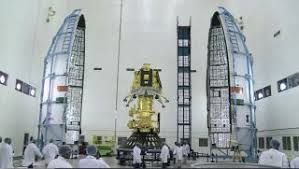
Chandrayaan-2
is the second lunar exploration mission developed by the Indian Space Research Organisation (ISRO), after Chandrayaan-1. It consisted of a lunar orbiter, the Vikram lander, and the Pragyan lunar rover, all of which were developed in India. The main scientific objective is to map and study the variations in lunar surface composition, as well as the location and abundance of lunar water.
The spacecraft was launched on its mission to the Moon from the second launch pad at the Satish Dhawan Space Centre on 22 July 2019 at 2.43 PM IST (09:13 UTC) by a GSLV Mark III. The craft reached the Moon’s orbit on 20 August 2019 and began orbital positioning manoeuvres for the landing of the Vikram lander. Vikram and the rover were scheduled to land on the near side of the Moon, in the south polar region at a latitude of about 70° south on 6 September 2019 and conduct scientific experiments for one lunar day, which approximates two Earth weeks. A successful soft landing would have made India fourth country after USSR, US and PRC to do so.
However, the lander deviated from its intended trajectory starting at 2.1 kilometres (1.3 mi) altitude, and had lost communication when touchdown confirmation was expected. Initial reports suggesting a crash were confirmed by ISRO chairman K. Sivan, stating that “it must have been a hard landing”. The Failure Analysis Committee concluded that the crash was caused by a software glitch.
ISRO may re-attempt a soft landing by November 2020 with Chandrayaan-3. The proposed configuration would include a detachable propulsion module, a lander and a rover.
History :
On 12 November 2007, representatives of the Russian Federal Space Agency (Roscosmos) and ISRO signed an agreement for the two agencies to work together on the Chandrayaan-2 project. ISRO would have the prime responsibility for the orbiter and rover, while Roscosmos was to provide the lander. The Indian government approved the mission in a meeting of the Union Cabinet, held on 18 September 2008 and chaired by Prime Minister Manmohan Singh. The design of the spacecraft was completed in August 2009, with scientists of both countries conducting a joint review.
Although ISRO finalised the payload for Chandrayaan-2 per schedule, the mission was postponed in January 2013 and rescheduled to 2016 because Russia was unable to develop the lander on time. Roscosmos later withdrew in wake of the failure of the Fobos-Grunt mission to Mars, since the technical aspects connected with the Fobos-Grunt mission were also used in the lunar projects, which needed to be reviewed. When Russia cited its inability to provide the lander even by 2015, India decided to develop the lunar mission independently.
The spacecraft’s launch had been scheduled for March 2018, but was first delayed to April and then to October to conduct further tests on the vehicle. On 19 June 2018, after the program’s fourth Comprehensive Technical Review meeting, a number of changes in configuration and landing sequence were planned for implementation, pushing the launch to the first half of 2019. Two of the lander’s legs got minor damage during one of the tests in February 2019.
Chandrayaan-2 launch was initially scheduled for 14 July 2019, 21:21 UTC (15 July 2019 at 02:51 IST local time), with the landing expected on 6 September 2019. However, the launch was aborted due to a technical glitch and was rescheduled. The launch occurred on 22 July 2019 at 09:13 UTC (14:43 IST) on the first operational flight of a GSLV MK III M1.
Objectives :
The primary objectives of the Chandrayaan-2 lander were to demonstrate the ability to soft-land on the lunar surface and operate a robotic rover on the surface. Scientific goals include orbital studies of lunar topography, mineralogy, elemental abundance, the lunar exosphere, and signatures of hydroxyl and water ice.[54] The orbiter will map the lunar surface and help to prepare 3D maps of it. The onboard radar will also map the surface while studying the water ice in the south polar region and thickness of the lunar regolith on the surface.
Design :
The mission was launched on a Geosynchronous Satellite Launch Vehicle Mark III (GSLV Mk III) with an approximate lift-off mass of 3,850 kg (8,490 lb) from Satish Dhawan Space Centre on Sriharikota Island. As of June 2019, the mission has an allocated cost of ₹ 9.78 billion (approximately US$141 million) which includes ₹ 6 billion for space segment and ₹ 3.75 billion as launch costs on GSLV Mk III. Chandrayaan-2 stack was initially put in an Earth parking orbit of 170 km perigee and 40,400 km apogee by the launch vehicle.
 INDIAN SPACE RESEARCH ORGANISATION