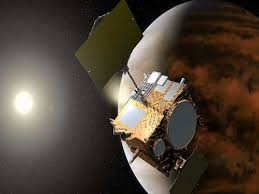
Shukrayaan-1 is a proposed orbiter to Venus by the Indian Space Research Organisation (ISRO) to study the surface and atmosphere of Venus.
Funds were released in 2017 to complete preliminary studies, and solicitations for instruments have been announced. If fully funded, it would be launched some time after the Mars Orbiter Mission 2 in the early 2020s. The orbiter, depending on its final configuration, would have a science payload capability of approximately 100 kilograms (220 lb) with 500 W available power. The initial elliptical orbit around Venus is expected to have 500 km (310 mi) at periapsis and 60,000 km (37,000 mi) at apoapsis.
Overview :
Based on the success of Chandrayaan and the Mangalyaan, ISRO has been studying the feasibility of future interplanetary missions to Mars and Venus, the closest planetary neighbours to Earth. The mission concept to Venus was first presented at a Tirupati space meet in 2012. The Government of India, in its budget for 2017–18 gave the Department of Space a 23% increase. Under the space sciences section, the budget mentions provisions “for Mars Orbiter Mission II and Mission to Venus”, and following the 2017–18 request for grants, it was authorized to complete preliminary studies. From 2016 to 2017, ISRO collaborated with JAXA to study the Venus atmosphere using signals from the Akatsuki in a radio occultation experiment.
The three broad research areas of interest for this mission include surface/subsurface features and re-surfacing processes; second: study the atmospheric chemistry, dynamics and compositional variations, and third: study the atmospheric interaction with solar radiation and solar wind.
Status :
On 19 April 2017, ISRO made an ‘Announcement of Opportunity’ (AO) seeking science payload proposals from Indian academia based on broad mission specifications. On 6 November 2018, ISRO made another ‘Announcement of Opportunity’ inviting payload proposals from the international scientific community. The available science payload capacity was revised to 100 kg from 175 kg mentioned in the first AO. As of late 2018, the Venus mission is in the configuration study phase and ISRO has not sought the Indian government’s full approval. Somak Raychaudhury, the director of IUCAA, stated in 2019 that a drone-like probe was being considered to be a part of mission.
Potential collaboration with France :
The space agencies of India (ISRO) and France (CNES) are holding discussions to collaborate on this mission and jointly develop autonomous navigation and aerobraking technologies.
In addition, French astrophysicist Jacques Blamont, with his experience from the Vega program, expressed his interest to U R Rao to use inflated balloons to help study the Venusian atmosphere. Just like during the Vega missions, these instrumented balloons could be deployed from an orbiter and take prolonged observations while floating in the relatively mild upper atmosphere of the planet. ISRO agreed to consider the proposal to use a balloon probe carrying 10 kilograms (22 lb) payload to study the Venusian atmosphere at 55 kilometres (34 mi) altitude.
Science payload :
The science payload would have a mass of 100 kg (220 lb) and would consist of instruments from India and other countries. As of December 2019, 16 Indian and 7 international payloads have been shortlisted. Some of them will be selected.
Indian instruments :
- Venus L&S-Band SAR
- VARTISS (HF radar)
- VSEAM (Surface Emissivity)
- VTC (Thermal Camera)
- VCMC (Cloud Monitoring)
- LIVE (Lightning Sensor)
- VASP (Spectro Polarimeter)
- SPAV(Solar occultation photometry)
- NAVA ( Airglow imager)
- RAVI (RO Experiment)*
- ETA (Electron Temperature Analyser)
- RPA (Retarding Potential Analyser)
- Mass Spectrometer
- VISWAS (Plasma Analyser)*
- VREM (Radiation Environment)
- SSXS (Solar Soft X-ray Spectrometer )
- VIPER (Plasma Wave Detector)
- VODEX (Dust experiment)
* RAVI and VISWAS are being proposed as collaboration with Germany and Sweden.
International instruments :
- Terahertz devices to generate powerful radar pulses. Proposed by NASA.
Two Russian payloads by the Russian Space Research Institute and Moscow Institute of Physics and Technology have been shortlisted, both would study the atmosphere of Venus:
- VIRAL (Venus InfraRed Atmospheric gases Linker) by Space research Institute,,Moscow & LATMOS, France
- IVOLGA: A laser heterodyne NIR spectrometer for studying of structure and dynamics of the Venusian mesosphere.
| Mission type | Venus orbiter |
|---|---|
| Operator | ISRO |
| Spacecraft properties | |
| Manufacturer | ISAC |
| Launch mass | 2,500 kg (5,500 lb) |
| Payload mass | ~100 kg (220 lb) |
| Power | 500 watts (0.67 hp) for payload |
| Start of mission | |
| Launch date | Proposed: 2023 |
| Rocket | GSLV Mark III |
| Launch site | SDSC SHAR |
| Contractor | ISRO |
| Venus orbiter Orbital parameters | |
| Pericythe altitude | 500 km (310 mi) |
| Apocythe altitude | 60,000 km (37,000 mi) |
| Venus atmospheric probe | |
| Spacecraft component | Aerobot balloon |
references : wikipedia
 INDIAN SPACE RESEARCH ORGANISATION